2019年2月25日星期一

Do You Know The Design Parameters Of These Roller Conveyors And The Motor Failure Solution?

#rollerconveyor #nonpoweredrollerconveyor #powerrollerconveyor #rollerconveyorsystem #rollerspiralconveyor

The roller conveyor has a simple structure, high reliability, and convenient use and maintenance. Applicable to the transportation of all kinds of boxes, bags, pallets, etc., bulk materials, small items or irregular items must be placed on the pallet or in the tote. The roller conveyor is capable of transporting a single piece of material that is very heavy or subject to large impact loads. The structure of the roller conveyor is divided into two types according to the driving method: a non-powered roller conveyor and apower roller conveyor. When selecting the roller conveyor, the food industry should give priority to the all-stainless steel body and stainless steel drum.

    Before customizing the roller conveyor, we first need to determine the following roller conveyor parameters:

    (1) the length, width and height of the object conveyed by the roller conveyor;

    (2) the weight of each conveying unit of the roller conveyor;

    (3) the bottom condition of the conveyor conveyed by the roller conveyor;

    (4) Whether there are requirements for special working conditions;

    (5) The roller conveyor belongs to the unpowered or motor driven type.

    The most common fault of the roller conveyor is the problem of the motor. The motor is the heart of the whole mechanical equipment. A slight carelessness will cause the roller conveyor to be difficult to operate for normal operation. The failure to deal with it is on the one hand, on the other hand. It is necessary to carry out regular maintenance and maintenance in order to make the life of the roller conveyor longer, and bring better economic benefits to the production enterprise.

    The most common failure of a roller conveyor during operation is that the motor cannot start or slow down immediately after a normal start. There are generally four reasons for this:

    (1) May be caused by a line fault. Solution: Perform line inspection of the roller conveyor at the first time;

    (2) It may also be caused by a drop in voltage. Solution: Check the roller conveyor voltage to ensure normal;

    (3) There may also be a failure of the roller conveyor contactor. Solution: At this time, it is necessary to check the overloaded electrical appliance for timely replacement;

    (4) Another possibility is that the roller conveyor is continuously operated for a short time in a short time. Solution: At this time, we only need to reduce the number of operations to return the roller conveyor to normal start-up.

2019年2月19日星期二

Do You Know The Structural And Practical Technology Of Conveyor Equipment?

#rubberbelt #conveyorequipment #rubberconveyorbelt
#clampingwasher #asteelsupporting #supportingframe #conveyorbracket

    In the industrial technology of the round tube rubber belt in the accessories of the conveyor equipment, we use the forming die and the round pipe pressing technology to rapidly shape the conveyor belt into a round pipe structure by heat vulcanization, and increase the conveying of the multi-layer fabric core inside. With a canvas layer, it can be seen from the analysis of the force at each point that such a structure has a higher level of resistance to flexing, and adopts a scientific manufacturing process to comprehensively improve the overall external resistance of the rubber conveyor belt, and is mainly used in industrial and mining production applications. It is used in the matching of round tube belt conveyors with different inclination angles;

    In addition, in the practical technology of the conveyor roller with clamping function, the structure is mainly composed of a clamping washera steel supporting piece and a connecting rod, and the protruding point is mainly to quickly press the rubber into a plurality of cushioning rubber rings. A clamping steel ring is installed at both ends of the drum, and a strong supporting frame is mounted on the main shaft, and the buffer rubber ring, the clamping bracket and the support frame are connected in series through the quenched connecting rod, in this way The belt drive roller is manufactured to ensure the satisfactory use of the special clamping type wear-resistant roller matched with the heat-resistant conveyor belt;

    Furthermore, how to make the endless conveyor belt have more precise correction technology, the transportation equipment manufacturer gives a more reasonable solution, the specific implementation method is: installing a sliding support at the bottom position of the beam on the belt conveyor frame. And the bearing set of the offset bearing type is welded on the main bearing mounting seat, the bearing seat can realize the smooth sliding of the front and rear, and then the rubber conveyor belt is penetrated in the inner groove of the adjusting roller set, and at the same time in the bearing One side of the seat is equipped with a large stroke cylinder, the cylinder joint is flexibly connected with the bearing seat, and a speed control valve is arranged at the outer edge of the nylon rubber belt. Through the design improvement of the above scheme, the heat resistant belt can be effectively controlled during the work process. The central deflection phenomenon enhances the comprehensive performance of the industrial belt machine;

    Finally, in the belt conveyor roller and its bracket interchange device, the manufacturing principle is mainly to machine two rectangular slots on the mating surface of the belt conveyor bracket fixing plate to make them perpendicular to each other. The straight slot is designed as a groove with an arc structure along the width direction of the fixing plate to start from the bolt mounting hole at the rightmost side of the fixing plate, and extends in an arc direction until the edge is penetrated into position, and the sound is heard By designing the product in this way, the manufacturer can completely improve the comprehensive interchange efficiency of the belt conveyor roller and its bracket, and fully meet the user's need for efficient operation in the field.


2019年2月18日星期一

What Are The Common Types Of Chains?

#stainlesssteelchain #selflubricatingchain #sharpchain #sidebendchain

The transmission of the equipment is generally based on the chain, which everyone should know. Different types of chains will appear in different types of needs, and the role played will be different. So today, we will introduce the common types of chains.

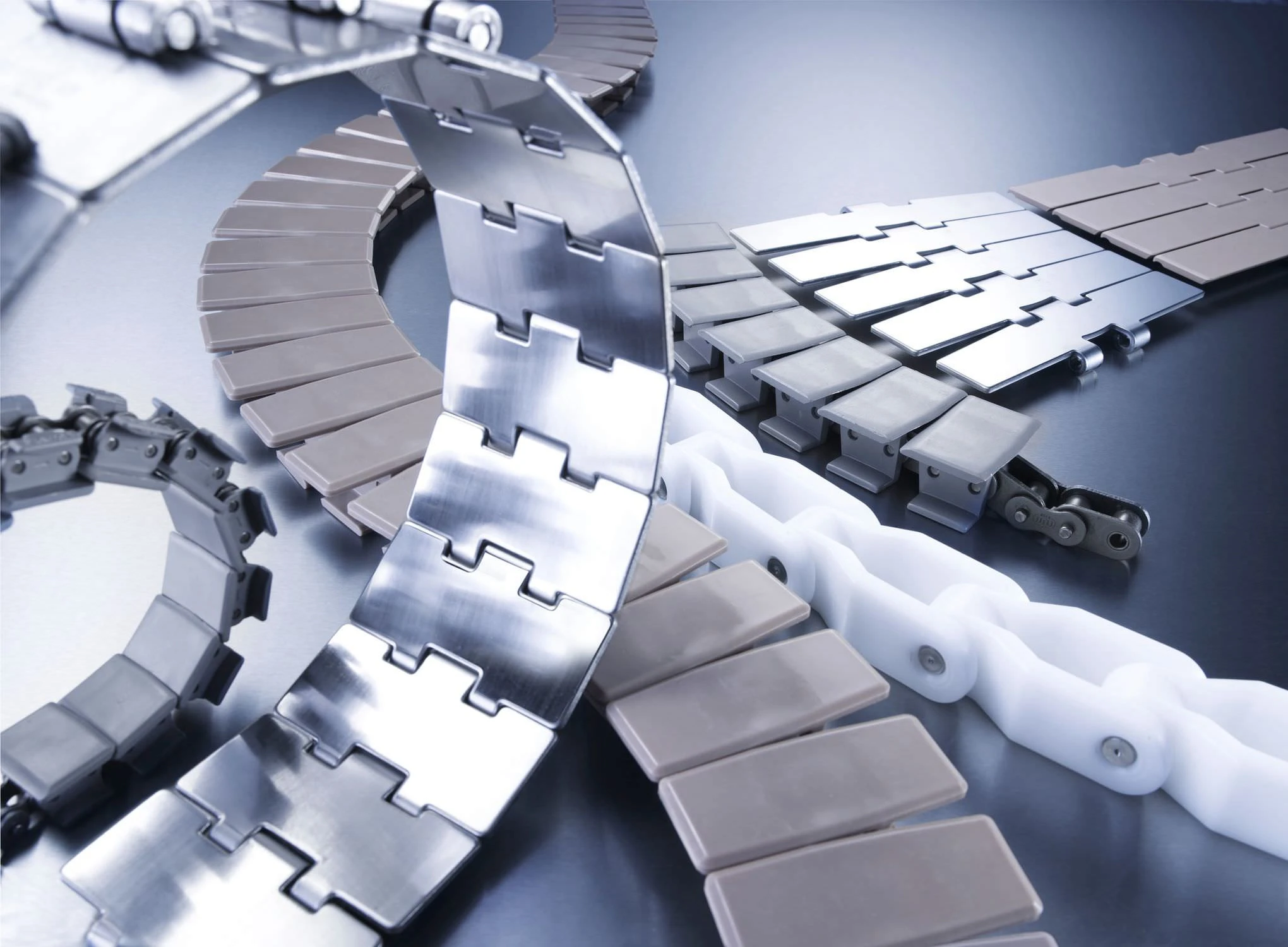
    Stainless steel chain: The parts are made of stainless steel. This type of chain is suitable for use in the food industry and susceptible to chemical and pharmaceutical erosion. It can also be used in high and low temperature applications.

    Nickel-plated chain, galvanized chain, chrome-plated chain: All carbon steel materials can be surface treated. The surface of the parts is nickel-plated, galvanized or chrome-plated. It can be used in outdoor rain erosion, but it can not prevent thick Chemical liquid corrosion.

    Self-lubricating chain: Some parts are made of a sintered metal impregnated with lubricating oil. This chain has excellent wear resistance and corrosion resistance, no maintenance (maintenance-free) and long service life. Widely used in high-force, wear-resistant requirements, and can not be often maintained, such as food industry automated production lines, high-end bicycle racing, less maintenance high-precision transmission machinery.

    O-ring chain: O-ring seals are installed between the inner and outer chain plates of the roller chain to prevent dust from entering and the grease flowing out of the hinge. The chain is strictly pre-lubricated. Because the chain has superior parts and reliable lubrication, it can be used in open drives such as motorcycles.

    Rubber chain: This type of chain is a U-shaped attachment plate on the outer link of the A and B series chains. Rubber is attached to the attachment plate (such as natural rubber NR, silicone rubber SI, etc.) to increase wear resistance and reduce Noise, increase shock resistance. For transport.

    Sharp chain: This chain is widely used in the wood industry, such as the feeding and output of wood, cutting, conveyor transport and so on.

    Agricultural machinery chain: Agricultural machinery chain is suitable for field working machinery such as walking tractors, threshers, combine harvesters, etc. This type of chain requires low cost but can withstand impact and wear. In addition, the chain should be greased or automatically lubricated.

    High-strength chain: It is a special roller chain. It can improve the tensile strength by 15~30% and improve the impact performance by improving the shape of the chain plate, thickening chain plate, fine-punching chain plate hole and pin shaft heat treatment. Fatigue performance.

    Side Bend Chain: This chain has a large hinge clearance and chain plate clearance, so it has greater flexibility for bending drive and conveying.

    Escalator chain: used for escalators and automatic walkways. Due to the long working hours of the escalator, the safety requirements are high and the operation is stable. Therefore, it is required that the step chain must reach the specified smaller ultimate tensile load, the total length deviation of the two paired chains, and the step distance deviation.

    Motorcycle chain: defined by the purpose of the chain, from the structure of the chain, there are two types of roller chain and sleeve chain, from the part used on the motorcycle, it has two types of use inside the engine and outside the engine. Most of the chains used in the engine are sleeve chain structures. The chain used outside the engine is the drive chain for driving the rear wheels, and most of them use roller chains. Such chains should pay special attention to ensure fatigue performance.

    Agricultural clamping conveyor chain: suitable for walking wheat, rice harvesters and fixed motorized rice and wheat threshers, as well as semi-feeding combine harvesters

2019年2月15日星期五

How To Identify If There Is Any Miscellaneous Material When Buying A Plastic Chain?

#plasticconveyorchains #chainlines #conveyingequipment #plasticchain

   Machinery is used in many places in life, and the effect is great. The machinery is generally driven by chains, and the chain is also diverse. Plastic conveyor chains are also one of them, but people should not be too small, and the effect is really great. However, the quality of plastic chains sold by manufacturers is different, there are good and bad, so people must be careful when buying, many plastic chains will be doped with miscellaneous materials, which will affect the quality. So how do we identify if it is doped with miscellaneous materials when buying plastic chains?

    First of all, it depends on whether the surface is flat or not, and the plastic chain made of miscellaneous materials is not flat. This is the obvious feature of the secondary material mixed injection molding.

    The second point is to see if the chain lines are smooth and smooth. Generally, the plastic chains made of new materials have the advantages of neat appearance, self-lubricating, etc., and the hand feels lubricated and not rough.

    Thirdly, in terms of use, the plastic chain made of miscellaneous materials can not achieve the original performance in application, such as being incapable of wearing and being easily broken, and the chain parts need to be replaced frequently.

    As an important part of the conveying equipment, the plastic chain carries an important part of material conveying or mechanical transmission. When purchasing plastic chains, we should pay attention to whether the plastic chain has quality problems. Keep in mind the above methods to identify high-quality plastic chains, so that your inferior products are getting farther and farther away from you.

2019年2月14日星期四

Improvement Of The Belt Conveyor Tail Wheel

#beltconveyor #PUbeltconveyor #PUPVCbeltconveyor

  In order to help the belt conveyor user solve some related defects, such as the outer surface of the tail roller is smooth, the belt conveyor is not easy to slip when starting and heavy loading; the tail roller is round, no anti-belt The function of deviation, the service life of the bearing is short; Hongjiang technicians have absorbed advanced experience at home and abroad, and combined with years of work experience in the industry, the structure of the traditional tail wheel part has been comprehensively improved, and the belt conveyor has been designed. The wing-shaped tail wheel part.
    The wing-shaped tail wheel part of the PU belt conveyor is mainly composed of a wing-shaped drum, a shaft, a conical expansion sleeve, an outer spherical bearing with a slider seat, a bearing bracket, a tension adjusting screw and the like. Compared with the traditional tail wheel, the wing-shaped tail wheel has the following remarkable features:
    1. The PU PVC belt conveyor bearing and bearing housing are of integral structure. This structure is extremely convenient in installation, use and maintenance, occupies small installation space, and reduces the process of machining the bearing seat in the production process. The wing roller and the shaft are connected by a conical expansion sleeve; the bearing is a spherical bearing with a slider outer ball, which can slide on a standard shaft, and the bearing and the shaft are fixed by a set screw;

    2. The belt conveyor adopts the radial ball bearing with the outer ball of the slider. Compared with the ordinary bearing, it adopts the integral casting seat. The bearing has high manufacturing precision, good self-aligning performance, large load bearing capacity, especially the sealing performance is particularly good. The service life of the bearing is greatly prolonged; in the traditional tail wheel part, the sand dust easily enters the bearing from the gap between the bearing cover and the shaft, which seriously shortens the service life of the bearing.

    3. The belt conveyor tension adjustment mechanism consists of only one screw and four nuts. The two upper nuts of the bearing seat are locked for a long time. Loosen the nut on the inner side of the bearing bracket and tighten the nut on the outer side of the bearing bracket. The belt is tightened, and the belt is loosened. The traditional adjustment mechanism of the tail wheel is composed of the adjusting screw, the upper cover and the lower bottom plate. The upper cover needs to be bent and drilled. It is necessary to drill and tap the teeth after welding, and the connecting bolts that need to be placed on the lower bottom plate of the upper and lower bottom plates are easily loosened. Therefore, the tension adjustment mechanism of the wing-shaped tail wheel portion is simpler and more convenient than the tension adjustment mechanism of the conventional tail wheel portion in the composition, the manufacturing process, and the assembly and disassembly, and the use is more reliable.

    4. The surface friction coefficient of the belt conveyor wing roller is large, and the belt is not easy to slip when starting and heavy loading. The outer circumference of the airfoil drum is distributed in the circumferential direction, and the gap between the wings of the width of 35-40 mm is 40-45 mm. Therefore, during the operation of the belt conveyor, the friction coefficient between the belt and the drum is very large and it is not easy to slip.

    5. The belt conveyor wing roller has self-cleaning effect. The flaps on the outer surface of the drum are connected to the mother pipe seamless steel pipe through the web, and the webs are separated by a partition plate, and the partition plate forms an angle of three to five degrees with the seamless steel pipe. During the use of the belt conveyor, if there is material scattered, the material will slide along the partition, so as to avoid the material being pulled between the belt and the roller with the return belt, which damages the belt and damages the drum.

    6. The intermediate diameter of the belt conveyor's wing-shaped roller is 5~10mm larger than the diameter of the end, which has the function of preventing the belt from running off.

    7. Since the surface friction coefficient of the belt conveyor wing roller is large, the diameter of the drum is significantly smaller than that of the conventional tail roller. Taking the B1000 belt conveyor as an example, the diameter of the conventional smooth roller is generally 500m, and the diameter of the airfoil roller is generally 300m-350m, which greatly saves raw materials.

    8. Since the belt of the wing-shaped roller is not easy to slip on the drum, the belt damage caused by the material being pulled between the belt and the drum can be avoided, and the belt is prevented from being deflected, so the service life of the belt is greatly improved.

2019年1月25日星期五

Belt Conveyor Speed Adaptation Problem

#thebelt #beltonveyor #rubberbeltconveyor #rubbermovableconveyor

 At present, one viewpoint is advantageous when the belt conveyor is operated with a belt speed adjustable state. This paper will quote the problems in the speed adjustment of belt conveyors, which are recognized as the research results. The influence of speed control on the life of various parts of the belt conveyor, whether the material filling rate has energy saving effect, the relationship between the running speed of the conveyor and the drag coefficient The vibration of the drive unit indicates that the speed regulation is unfavorable.

1. General view of speed control of belt conveyor
Generally, the speed control of the belt conveyor is mainly for the start-up process of the conveyor, and the purpose is to reduce the dynamic load of the belt conveyor system, and the belt conveyor runs at a constant speed after the start of the belt conveyor. The purpose of controlling the belt speed during normal operation of the belt conveyor is to ensure that the average material fill rate is always kept at a maximum. If the conveyor speed is constant, when the amount of material to be conveyed is reduced, the cross-sectional area of ​​the material is reduced, and when the speed regulation mode is adopted, when the amount of material to be conveyed is reduced, the filling rate of the material is maintained by reducing the belt speed. In the past, this measure was mistaken for extending the service life of the conveyor belt joints and thus extending the service life of the entire conveyor belt. The following findings will be used to prove that this view is incorrect.

1. Influence of belt conveyor speed control on the drive system
First, the relationship between the various components of the belt conveyor and the speed of the conveyor belt is analyzed. Figure 1 is a schematic view of the main components of the belt conveyor. The belt conveyor mainly consists of two rollers (head roller and tail roller); of course, the long-distance belt conveyor needs more rollers. For reasons of space, the drive unit is not mounted on the front end of the conveyor, but is mounted in the rear of the face roller.

(1) Belt conveyor feeding/unloading
The design of the unloading system requires consideration of several factors. The first is the flow characteristics of the material. Depending on the flow characteristics, the unloader is usually designed as a chute or a bin to prevent material from adhering to the surface or pile up. At the same time, the discharge direction must be consistent with the running direction of the conveyor belt (ideally at the same speed) to prevent the material from slipping on the conveyor belt and causing wear. For some special factors, it should be considered according to the actual situation, such as material humidity, to ensure smooth discharge. Other factors to consider include: material specific gravity, material particle size, and the center of gravity distribution of the particles. These parameters determine the material trajectory (parabola) at the time of unloading: when the material is discharged from the drum, the light and fine material is denser than the heavy and coarse material. For the feeding device, it must be designed in a targeted manner.
Obviously, the factors mentioned above have a great impact on the design of the discharge point. If the speed of the belt conveyor is variable, the discharge point must be adjusted to the changing material path (parabola) to prevent material from adhering or accumulating (a challenge for design engineers).

(2) Belt conveyor roller/roller
For the same belt conveyor system, as long as the system is centered, the carrying roller face and the roller are rarely worn. Therefore, the factor that actually limits the life of the carrying roller is the bearing.
The service life of a bearing is highly dependent on the load (in inverse proportion), not the speed. Therefore, if the average filling rate on the conveyor belt is always high due to the control of the speed, the service life of the bearing is lowered.

(3) Belt conveyor materials
The revised German standard DIN 22101 also takes into account the fatigue strength of conveyor belt joints. The fatigue resistance indicates the service life of the conveyor joint (depending on the change cycle of the belt tension and load). The duty cycle refers to the cyclic change cycle of the conveyor belt load from high tension to high tension. For example, when the conveyor belt rotates around the drum, the conveyor belt is subjected to direct extrusion of the drum and stretching in the outer diameter direction, that is, the conveyor belt is in a high tension state. The change in load is accounted for by the tensile length of the conveyor belt before and after unloading (ie, the difference in length between the belt being straightened and sagged).
Conveyor belt depression resistance is mainly determined by the belt tension and the material load on the conveyor belt. The greater the tension, the smaller the conveyor belt depression resistance; the greater the material load, the greater the conveyor belt depression resistance.
However, the belt tension is only affected to some extent. On the one hand, the transitional sagging of the conveyor belt is not allowed by the design specifications. On the other hand, the traction must also be as small as possible. Therefore, the only adjustable material load is the material load. With the conveyor belt constant, the roller bending resistance will decrease as the load is reduced.

(4) Belt conveyor drive
The bearings and shafts of the transmission have different natural frequencies, and short-term operation (that is, during the traditional starting process) does not cause harm, but if it is operated for a long time (when they reach the critical bending frequency), the transmission will be Causes great damage and equipment damage. This study is based on frequency analysis. The study also found that in order to avoid damage to the transmission, the belt conveyor can no longer be operated in a specific speed range. By analyzing the frequency of a 1000kW class transmission, it is possible to have a narrow speed window between 400r/min and 500r/min. There is also a speed between 650r/min and 900r/min and 1200r/min. Speed ​​window. If the conveyor is running in these speed ranges for a long time, there may be a resonance accident.
It should also be pointed out that the affected speed range will certainly be affected by different proportions, different materials and different material strengths.

(5) Belt conveyor control
It can be seen that in the case of large changes in load and no-load, the conveyor belt speed is reduced to some extent, which may cause material overflow at the discharge point. In addition, it should be noted that speed control through the corresponding monitoring of the load amount will consume a lot of labor. Conveyor speed does not increase or decrease immediately, and it takes a while to increase or decrease. Taking into account the situation at the discharge point mentioned in the previous overview, the control system must be able to adapt to the reload during this time period.
The claim that speed control of belt conveyors can save energy has proven to be erroneous. The advantages of constant belt speed and varying loading have been verified, and the idea that control speed prevents belt wear has been denied. In summary, the problems posed by conveyor belt control measures have been proven.

Therefore, you should try to break through the bottleneck of the belt conveyor and always operate with full load material to maximize the benefits without having to find a solution that needs to reduce the speed of the conveyor belt.
2019年1月21日星期一

New Chain Conveyors Rely On Core Technology Development

#chaintransportmachinery #drugchainconveyors #chainconveyormachinery #conveyordesigners #drugchainconveyormachinery #drugdeliverymachinery #productionofmachinery #twochainconveyors

    Throughout the entire conveyor industry, we found that the overall technical level of the domestic chain conveyor is not enough, and can not produce the first delivery equipment. In addition, there is no perfect development plan in the industry, and the government lacks corresponding macro-control, resulting in the backward development of domestic chain-transport machinery.

    The products produced to meet the needs of the international market need to be transported at an international level. In the future, the market of chain conveyors in China will grow rapidly. In the field of medicine, the demand for transportation has also increased rapidly, which has promoted the development of drug chain conveyors at a certain level.

    Advanced chain conveyor machinery adopts a number of new detection systems to ensure the stable and reliable operation of the chain conveyor. With the increasing penetration of automation vendors and the development of information technology, more and more conveyor designers have accepted advanced automation technology and used advanced automation products to improve equipment performance. The overall level of China's chain conveyors has been behind the level of developed countries for many years. In addition to the improvement of the technical level of domestic manufacturers, the localized production of foreign manufacturers has also greatly promoted the automation level of China's chain conveyors. The trend toward internationalization is the purpose of drug delivery machinery. However, it is far from enough to rely on the slogan. The drug chain conveyor machinery wants to truly embark on the international stage. To move toward the high end, it must conform to the development trend of the times. Modern technology is integrated into the production of machineryto complete the efficient and intelligent equipment.

    The new chain conveyor machinery is often a mechatronics device that makes full use of the latest achievements in information products. The designers of some Chinese companies are unfamiliar with electronic products, and they dare not or will not choose, which greatly limits the level of chain conveyors. For example, many foreign new chain conveyors have adopted separate transmissions, which has greatly shortened the transmission chain of the whole machine, greatly simplified the structure, and greatly improved the work accuracy and speed. One of the core technologies is to adopt the synchronization technology of multi-motor drag. In fact, it is not difficult to master this technology, but some designers do not understand the development trend of the chain conveyor. Another core technology is the large adoption of servo drives, but the old designers will not design and use servos and their control systems.

    Entering the international market has become an important goal for the development of China's transportation industry. If the drug chain conveyor machinery wants to truly enter the international arena and move toward the high-end, it must conform to the development trend of the times and integrate modern technology into the production of machinery to complete the efficient and intelligent equipment. In the future, the development direction of the drug delivery industry will be through the continued application and promotion of high-tech, arming and strengthening the overall level of the industry, and continue to improve the localization of high-end transportation equipment through technology improvement and optimization.

    After two or three decades of development, China's transportation industry continues to develop. Although China has become the second largest transportation country in the world, there are still many shortcomings compared with other countries. At present, China is constantly exploring the international market, and technology is still a short-board.

    The ordinary chain conveyor is based on the standard chain plate, and is driven by the motor reducer. We can make the chain conveyor wide and form a differential through multiple rows of chain plates, using multi-row chains. The speed difference of the board makes the multi-column conveying become a single-row conveying without extrusion, so as to meet the requirements of single-column conveying of beverage labeling, filling, cleaning and other equipment, we can make the head and tail of the two chain conveyors The overlapping mixed chain makes the bottle (can) body in a dynamic excessive state, so that the material is not retained on the conveying line, and the empty bottle and the solid bottle pressure and pressureless conveying can be satisfied. In the production of chain conveyor, our company relies on advanced technology development and has gained the trust of consumers. Therefore, both the ordinary chain conveyor and the new type of chain conveyor rely on the advantages of technology in the transportation industry.